Plywood, also known as laminated board or engineered wood, is a type of industrial wood made from multiple thin layers of wood (veneers) that are arranged in either parallel grain direction (LVL), non-parallel grain direction (LVB), or cross-laminated grain direction (LVD), and bonded together using specialized industrial adhesives developed for the wood industry. This is an engineered wood product with a history of over 100 years and continues to play a vital role in construction, interior design, and the export manufacturing sector.
Compared to other engineered wood materials such as MDF, HDF, or MFC, plywood stands out for its mechanical strength, moisture resistance, and long-term dimensional stability.
A plywood panel consists of multiple odd-numbered layers (e.g., 3, 5, 7):
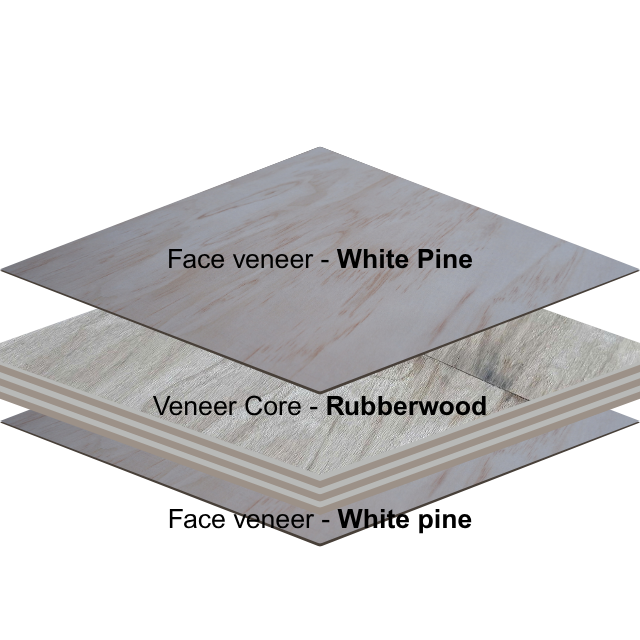
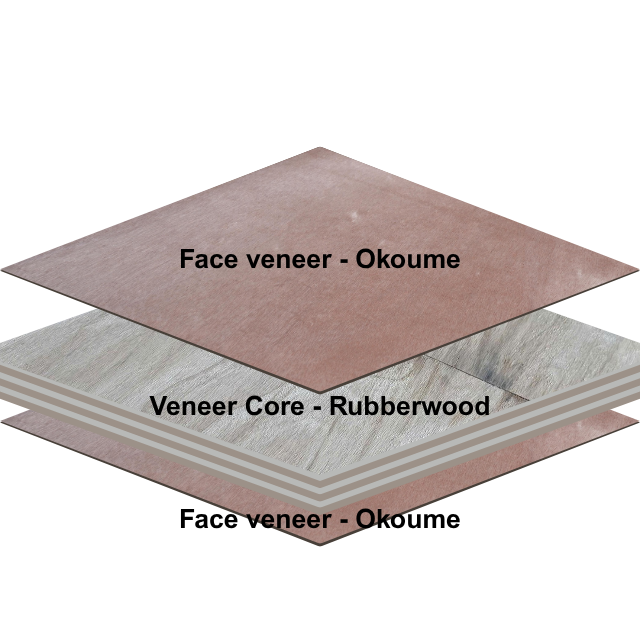
Core Veneer: Made from plantation wood such as rubberwood, eucalyptus, acacia, or poplar.
Adhesive Layer: Types of glue include PF (Phenol Formaldehyde) or UF (Urea Formaldehyde). Glue type determines the panel’s water resistance and formaldehyde emission level (E0, E1, etc.).
Face Veneer: Decorative outer layers made from natural wood veneer like Okoume, White Pine, Poplar, Birch, or engineered veneer (EV) provide surface beauty and consistency.
According to research in Polymers (2020), cross-laminated plywood is one of the most effective engineered wood materials in terms of strength-to-weight ratio and dimensional stability.
.png)
Each type of wood panels has its own advantages and disadvantages depending on the intended use and specific needs. However, in terms of mechanical and physical properties as well as environmental friendliness, plywood holds a clear advantage over others.
| Feature | Plywood | MDF / HDF | MFC / PB |
|---|---|---|---|
| Mechanical Strength | Very High | Moderate | Low |
| Moisture Resistance | Good (with PF/WBP glue) | Low | Low |
| Screw Holding Capacity | Excellent | Moderate | Poor |
| Surface Aesthetics | Natural wood grain (real veneer) | Smooth, easy to paint | Decorative but artificial |
| Eco-Friendliness | FSC-certified, low emission | Varies by glue | Often hard to trace |
More expensive than MDF/MFC
Requires precision cutting to avoid chipping edges
Heavier than MDF for the same size
ANN PLYWOOD specializes in premium-grade veneered plywood panels with a rubberwood core, manufactured to meet international standards including FSC CoC and FSC 100%, EPA TSCA Title VI and CARB P2. These products are ideal for interior furniture and export applications.
.png) |
|
.png) |
|
 |
|
 |
|
Website: annplywood.vn
Email: sales@annplywood.vn
Phone Number: (+84) 909 227 997 (Zalo/Whatsapp/SMS)